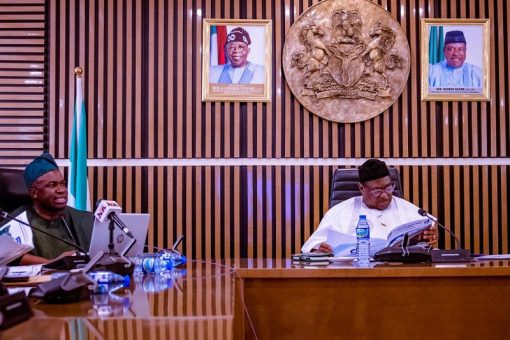
The Federal Government has inaugurated an inter-agency technical committee to evaluate a proposed $200 billion Integrated Gas, Power and High-Speed Rail Project, underscoring a cautious approach to one of the most ambitious infrastructure plans in Nigeria’s history.
Secretary to the Government of the Federation, George Akume, while inaugurating the panel in Abuja, tasked members with conducting a comprehensive, objective and professional review to guide decision-making in the national interest.
The committee will assess a proposal submitted by De-Sadel (Nig.) Limited in partnership with China Liancai Petroleum Investment Holdings Limited. The plan outlines a multi-phase project integrating gas development, power generation and transmission, alongside a 4,000-kilometre high-speed rail network.
Akume stressed that the magnitude and complexity of the proposal require thorough scrutiny, noting that government approval would depend on its technical feasibility, financial structure and compliance with regulatory standards.

“I urge you to approach this assignment with the highest level of professionalism, objectivity and patriotism. Your recommendations will guide decisions at the highest level,” he said.
He added that inputs had already been received from security, financial intelligence and regulatory agencies—particularly concerning funding arrangements and participating entities—highlighting the need for a coordinated review.

The proposed infrastructure is designed to connect key economic hubs, including Lagos, Abuja, Kaduna, Kano and Port Harcourt, through high-speed rail, while strengthening energy supply via integrated gas and power systems.
The government believes the initiative, if proven viable, could revolutionise transportation, improve energy security, drive industrial growth and promote national integration.
The committee, chaired by the Permanent Secretary of the Political and Economic Affairs Office in the SGF’s office, comprises representatives from key ministries, including Transportation, Petroleum Resources, Finance, Justice and Environment.
Other participating agencies include the Infrastructure Concession Regulatory Commission, Nigerian Electricity Regulatory Commission, Central Bank of Nigeria, Economic and Financial Crimes Commission, Department of State Services and the Nigeria Governors’ Forum Secretariat, among others.
Its mandate includes verifying proof of funds, assessing financial and sovereign risk exposure, reviewing the financing model and evaluating the technical capacity of promoters and contractors.
The panel will also examine rail infrastructure plans, local content provisions, regulatory compliance, as well as potential security and reputational risks before advising on the project’s readiness for consideration by the Federal Executive Council.
Managing Director of the De-Sadel Consortium, Samuel Ukoh, described the project as a transformative infrastructure backbone for the country, incorporating nationwide rail connectivity, gas-powered electricity generation, fibre optic networks and real estate development around major stations.
According to him, the first phase will span a 1,700-kilometre corridor linking Abuja, Lagos, Kano and Port Harcourt, with trains expected to reach speeds of up to 350km per hour—cutting travel time between Lagos and Abuja to about two hours and 30 minutes.
Ukoh added that the initial phase would generate approximately 3,500 megawatts of electricity to power the rail system, while the full project is projected to deliver up to 8,500 megawatts nationwide.