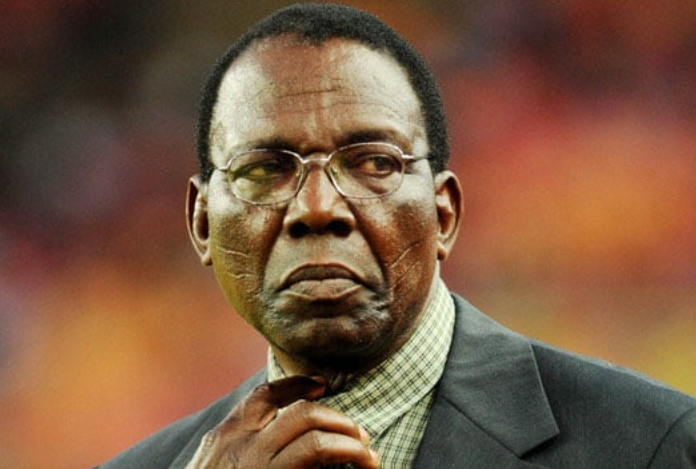
Nigeria’s sporting community has been thrown into mourning following the death of legendary football coach and administrator Adegboye Onigbinde, who passed away on Monday, March 9, at the age of 88.
Tributes have poured in from across the country and beyond, celebrating the remarkable legacy of the former Nigeria national football team head coach.
Leading the condolences, President Bola Ahmed Tinubu sympathised with the late tactician’s family and associates, describing him as a disciplined and visionary figure in Nigerian football.

In a statement issued through his Special Adviser on Information and Strategy, the president highlighted Onigbinde’s historic appointment in 1982 as the first indigenous coach of the Super Eagles.
“The accomplished football manager will be remembered for his discipline, integrity, foresight, and passion for the round-leather game,” Tinubu said, recalling the coach’s leadership in guiding Nigeria to the final of the 1984 Africa Cup of Nations.

The National Sports Commission (Nigeria) also expressed deep sorrow over the loss, describing Onigbinde as an enigma whose influence extended across the global football ecosystem.
Director General of the commission, Bukola Olopade, praised the late coach’s decades-long dedication to the growth of Nigerian football.
“High Chief Adegboyega Onigbinde has been nothing short of a football legend. His patriotism and contributions to the development of Nigerian football for over five decades cannot be overemphasised,” Olopade said.
Similarly, the Nigeria Football Federation (NFF) described his passing as the loss of a great icon. According to the federation’s General Secretary, Mohammed Sanusi, Onigbinde made history as the first indigenous coach to lead Nigeria at the 2002 FIFA World Cup.
Beyond his role with the national team, Onigbinde built a distinguished coaching career at club level. He led Shooting Stars SC of Ibadan to the final of the African Champion Clubs Cup in 1984 and earlier guided Water Corporation FC (Ibadan) to the competition’s quarter-finals in 1977.
The revered coach also served as a technical instructor for global football governing bodies FIFA and Confederation of African Football (CAF), travelling widely to train and mentor coaches.
Secretary General of the World Olympians Association, Olumide Oyedeji, urged Nigerians to uphold the discipline and football intelligence the late coach instilled in his players.
“He did not just coach; he engraved courage. Nigerians should take solace in the fact that he lived a life of purpose,” Oyedeji said.
Born in Modakeke, Osun State, Nigeria, Onigbinde dropped the name “Festus” in 1960 and adopted Adegboye, meaning “a child born to reclaim a chieftaincy title.”
In a statement issued by family representative Bolade Adesuyi, the family expressed gratitude to God for his fulfilled life of service and said funeral arrangements would be announced at a later date.
Widely regarded as one of Nigeria’s most influential football minds, Onigbinde’s legacy as a coach, educator, and mentor is expected to endure for generations.