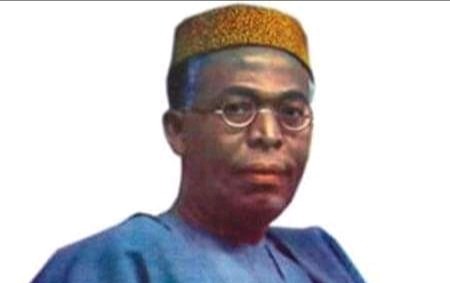
Tinubu Hails Awolowo as Visionary ‘Sage’, Says His Legacy Still Guides Nigeria’s Leadership
President Bola Ahmed Tinubu has described late nationalist leader Obafemi Awolowo as a courageous and visionary statesman whose leadership transformed not only the South-West but also laid a lasting foundation for Nigeria’s socio-economic development.
Tinubu made the remarks on Friday while delivering a keynote address at the 2026 Obafemi Awolowo Memorial Lecture held at Efunyela Hall in Ikenne, Ogun State. The president, represented by the Minister of State for Health and Social Welfare, Dr Isiaq Adekunle Salako, paid tribute to Awolowo’s enduring legacy of bold leadership and people-focused governance.

According to Tinubu, Awolowo’s leadership style distinguished him among Nigeria’s political figures, earning him the reputation of a “sage” whose ideas and policies have continued to influence generations.
Awolowo: ‘The Best President Nigeria Never Had’

The president described the late premier of the Western Region as one of Nigeria’s most respected political thinkers and administrators, often regarded as “the best president Nigeria never had.”
He noted that Awolowo’s integrity, intellectual depth, and courage in implementing welfare-driven policies propelled the Western Region to the forefront of development in Nigeria.
Tinubu highlighted Awolowo’s transformative initiatives in education, healthcare, and infrastructure as key policies that reshaped the socio-economic landscape of the South-West.
Free Education Policy That Changed History
One of Awolowo’s most notable policies was the introduction of the Universal Primary Education programme in 1955. According to Tinubu, the initiative initially faced strong opposition from British colonial authorities, political rivals, and even some parents who preferred their children to work on farms.
Despite the resistance, Awolowo remained firm in implementing the programme, insisting that education was essential for long-term societal development.
“You may hate me today, but tomorrow you will thank me,” Awolowo famously said while defending the controversial policy — a prediction Tinubu said has since proven accurate.
The president noted that the success of the programme demonstrated Awolowo’s willingness to make difficult decisions for the long-term benefit of society rather than pursue short-term populist policies.
Infrastructure Expansion and Governance Benchmark
Beyond education reforms, Tinubu also praised Awolowo’s ambitious infrastructure development, which saw the construction of over 2,000 kilometres of roads across the Western Region.
According to him, the scale of development achieved under Awolowo was nearly ten times the road infrastructure inherited from the British colonial administration.
He also referenced Awolowo’s leadership of the Unity Party of Nigeria between 1979 and 1983, during which governors in the South-West and Midwest implemented the party’s four cardinal programmes: free education, free healthcare, integrated rural development, and full employment.
Tinubu said those policies continue to serve as a benchmark for governance across Nigeria.
Tinubu Links Reforms to Awolowo’s Legacy
The president further revealed that Awolowo’s courage and visionary leadership have influenced his own approach to governance.
Tinubu said his administration has undertaken bold economic reforms aimed at rescuing Nigeria from fiscal challenges, arguing that many past governments avoided difficult structural decisions in favour of temporary relief measures.
According to him, current economic reforms have begun to stabilise the nation’s economy, pointing to improvements in GDP growth, inflation trends, foreign reserves, and debt-service ratios.
He urged Nigerians to remain patient and supportive of the reform agenda, stressing that major economic transformations require time and collective commitment.
Preserving Awolowo’s Intellectual Legacy
Tinubu also commended the Obafemi Awolowo Foundation for preserving the late leader’s intellectual and policy legacy through annual lectures and public engagement since its establishment in 1992.
He called on institutions and citizens to promote objective dialogue, national unity, and constructive discourse as Nigeria continues to pursue peace, stability, and sustainable development.
According to the president, Awolowo’s life remains a reminder that meaningful leadership requires courage, vision, and a steadfast commitment to policies that secure the future of generations yet unborn.