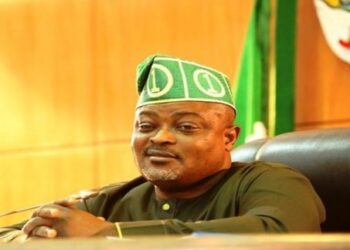
Political manoeuvring has begun for the position of Nigeria’s Minister of Power as the incumbent, Adebayo Adelabu, prepares to resign from the cabinet to contest the 2027 Oyo State governorship election.
Sources familiar with the development revealed that several interested individuals have begun lobbying the presidency for the position, anticipating Adelabu’s exit from the Federal Executive Council.
Barring any last-minute changes, Adelabu is expected to step down from his role in the coming weeks to pursue the governorship ticket of the All Progressives Congress (APC) in Oyo State.

The move aligns with the provisions of the Electoral Act 2026 and the election timetable released by the Independent National Electoral Commission (INEC), which schedules party primaries and dispute resolution processes between April 23 and May 30, 2026.
Adelabu had earlier hinted at his political plans during a meeting with stakeholders in the Nigerian Electricity Supply Industry (NESI) in Lagos late last year, when he stated that he hoped to achieve certain milestones “before I leave office.”

According to aides close to the minister, the remark was a clear signal of his intention to return to Oyo State politics.
In a viral video from October 2025, the former Deputy Governor (Operations) of the Central Bank of Nigeria formally declared his intention to contest the Oyo governorship election.
Reflecting on his previous attempts, Adelabu recalled how he lost to the incumbent governor, Seyi Makinde, in both 2019 and 2023.
“I have now paid my dues. I contested against Seyi in 2019 and again in 2023 as the sitting governor. But in 2027, God has shown that it is our turn,” Adelabu said at the time.
When contacted on the possibility of the minister’s resignation, his media aide, Bolaji Tunji, said there had been no directive from President Bola Tinubu asking cabinet members with political ambitions to step down.
“We need to await developments, as I am not sure the President has said those with political ambition should resign,” Tunji said.
Meanwhile, stakeholders in the power sector have urged President Tinubu to appoint a technocrat to replace Adelabu if he eventually leaves office.
A power sector expert, Bode Fadipe, said the next minister must possess deep knowledge of the electricity industry and prioritise national interest.
“My choice will be a technocrat who understands the power sector and whose agenda is national rather than personal,” Fadipe said.
Similarly, Adetayo Adegbemle, convener of PowerUp Nigeria, stressed that Adelabu’s successor must clearly understand the sector’s challenges and demonstrate that knowledge before being appointed.
Adegbemle also called for reduced political interference in the power sector, noting that electricity reforms are critical for industrialisation, job creation and economic growth.
“The power sector is central to our economy. Whoever becomes minister must see the role as an economic driver rather than a political platform,” he said.
Energy scholar Prof. Dayo Ayoade also emphasised the need for a technocrat capable of stabilising the struggling electricity sector.
“The sector is collapsing; we need someone who can manage the crisis,” he said.
However, a different view came from Adeola Samuel-Ilori, coordinator of the Electricity Consumers Forum, who suggested that the ministry should be temporarily managed by its Permanent Secretary until after the election cycle.
According to him, appointing a new minister at this stage could be unnecessary given the political environment.
Adelabu, a former banking executive and one-time Central Bank of Nigeria Deputy Governor (Operations), was appointed Minister of Power in 2023 by President Tinubu.
His appointment initially drew mixed reactions from industry stakeholders, some of whom questioned his technical expertise in the electricity sector.
Despite the criticism, Adelabu maintained that his mandate was to reform the power sector, not to function as an engineer or technician.
If he proceeds with his governorship ambition, his resignation could trigger a major leadership transition in one of Nigeria’s most critical and challenging ministries.