Nigeria basked in rare royal splendour last week as President Bola Ahmed Tinubu was accorded a grand state reception during his two-day official visit to the United Kingdom, signalling what many observers describe as a renewed global standing for the nation.
From the historic grounds of Windsor Castle to the corridors of 10 Downing Street, the visit—concluding on March 19—was marked by elaborate ceremonies, high-level engagements, and strategic agreements.
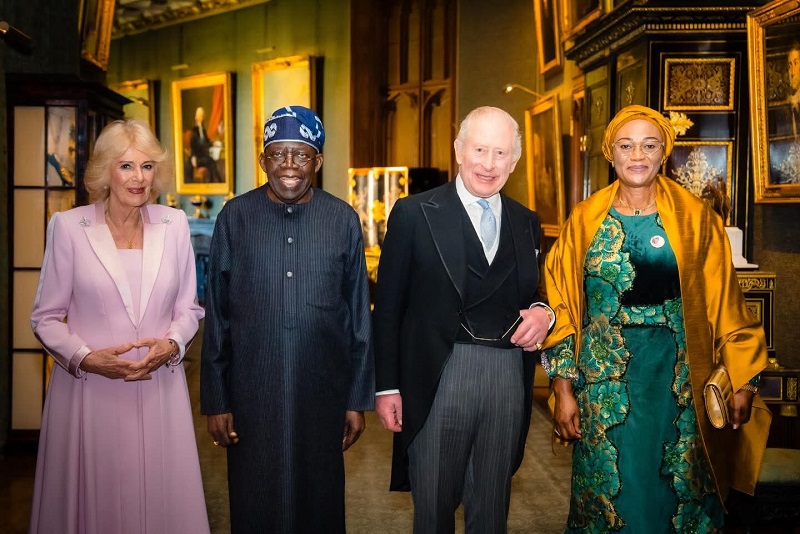
President Tinubu and First Lady Oluremi Tinubu were formally received by King Charles III and Queen Camilla at Windsor Castle, where the Nigerian leader inspected a guard of honour and witnessed a 42-gun salute. A state banquet later underscored the warmth of diplomatic ties, with both leaders exchanging remarks that reflected deep mutual respect and shared aspirations.

The visit, widely described as historic, comes 37 years after a similar engagement by former military ruler Ibrahim Babangida in 1989. Unlike that era, Nigeria’s current democratic landscape—now over two decades old provided a different backdrop, amplifying the significance and reception of Tinubu’s visit.
Observers noted the personal rapport between Tinubu and King Charles III, whose longstanding familiarity with Nigeria added a layer of warmth to the proceedings. The British monarch emphasised the growing interdependence between both nations, highlighting investments, education partnerships, and cultural exchanges.

Beyond the pageantry, the visit delivered tangible economic outcomes. Nigeria and the UK signed a £746 million financing agreement to refurbish key infrastructure at Apapa Quays and Tincan Port Complex an initiative expected to boost trade efficiency and logistics.
Trade relations between both nations remain robust, with total bilateral trade valued at £8.1 billion—an 11.4 percent increase year-on-year. Nigeria’s exports, largely crude oil, stand at £1.0 billion, while UK exports to Nigeria, dominated by refined oil, are valued at £1.6 billion.
Further strengthening economic ties, Nigerian financial institutions such as Zenith Bank and Fidelity Bank continue expanding their footprint in the UK, alongside growing investments in fintech, manufacturing, and education.
At Downing Street, President Tinubu held bilateral talks with British Prime Minister Keir Starmer, focusing on trade, economic cooperation, climate change, security, and global tensions. Both leaders reaffirmed their commitment to deepening collaboration across key sectors.
The visit also spotlighted cultural diplomacy, as Tinubu attended an art exhibition at Tate Modern, celebrating Nigerian creativity and innovation.
While the visit lasted just two days, its impact is expected to resonate far beyond, reinforcing Nigeria’s diplomatic influence and economic partnerships on the global stage.