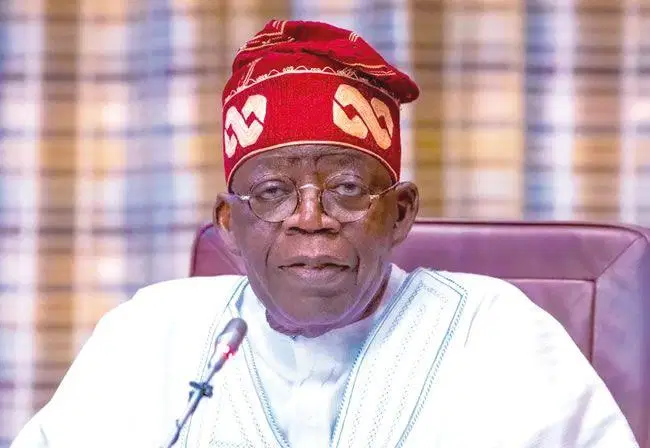
President Bola Tinubu has assured a delegation from the World Bank that Nigeria’s bold economic reforms are irreversible, describing them as critical to unlocking the country’s vast potential, driven by its youthful population and expansive arable land.

The President gave the assurance at the State House, Abuja, while receiving the World Bank delegation led by its Managing Director of Operations, Anna Bjerde, following a briefing by the Minister of Finance and Coordinating Minister of the Economy, Wale Edun, and Vice President Kashim Shettima.
Expressing pleasure at the meeting, Tinubu said Nigeria had fully committed to the reform path.

“Since we have gone into this tunnel of reform, we have our hands on the power and we’re never going to look back,” he declared.
Acknowledging the initial hardships associated with the reforms, the President said resilience was essential for long-term success.
“Initially, it was painful and difficult, but those who win are not the ones who give up in difficult times,” he said.
Describing Nigeria as “the heart of the continent,” Tinubu stressed the need for decisive action, with agriculture identified as a major priority. He highlighted ongoing efforts to expand mechanisation and establish centres to support farmers with improved seedlings and modern tools.
“How do we employ mechanisation and make agriculture easier? I have embarked on that,” he said, while inviting the World Bank to support Nigeria’s seedling and productivity programmes.
The President also pointed to opportunities in linking agriculture with Nigeria’s growing petrochemical and fertiliser industries, aimed at boosting yields and transitioning farmers from small-scale operations to large cooperatives.
Reaffirming his commitment to transparency and accountability, Tinubu said subsidy removal and macroeconomic discipline were necessary sacrifices to stabilise the economy.
“We’re not looking back. Transparency, accountability and change are non-negotiable,” he said, adding that a stable currency benefits both Nigerians and investors.
Tinubu noted that although reforms initially triggered high inflation, conditions had improved.
“Inflation has come down dramatically. The naira is stable, and today we can support investors with ease of doing business,” he said.
Calling for deeper collaboration, the President urged the World Bank to explore innovative financing models that reflect Nigeria’s large population and development needs.
In her remarks, Anna Bjerde commended Nigeria’s leadership for maintaining reform momentum over the past two years, describing the country as a frequent reference point in global policy discussions.
“Nigeria is a frequent example in my discussions with presidents, policymakers and investors around the world,” she said, adding that the steady communication of reforms had boosted confidence.
She disclosed that the World Bank had aligned its Country Partnership Framework (CPF) with Nigeria’s ambition of achieving a $1 trillion economy and 7 per cent growth, with emphasis on job creation to harness Africa’s demographic surge.
According to Bjerde, priority areas include infrastructure development, agricultural mechanisation, SME financing, and human capital development, particularly early childhood education to address stunting.
She said the World Bank’s support package for Nigeria includes $17 billion in public financing, $5 billion annually through the International Finance Corporation (IFC) for private sector mobilisation, and expanding MIGA guarantees exceeding $500 million.
“Our partnership must resonate with the people of Nigeria. Nigeria is always top of my mind when asked which African country to watch,” Bjerde said.