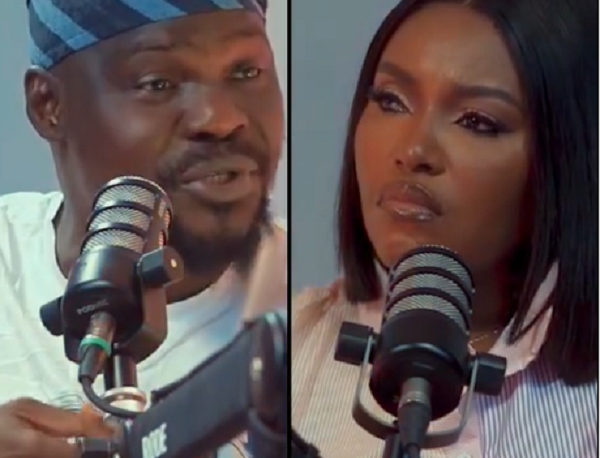
Nollywood actress Biola Adebayo has come under intense public scrutiny after featuring convicted actor Olanrewaju Omiyinka, popularly known as Baba Ijesha, on her podcast, Talk To B.
The interview has triggered widespread outrage across social media platforms, with many Nigerians accusing Adebayo of providing a platform for the disgraced actor to downplay his conviction for sexual offences involving a minor.
During the controversial episode, Baba Ijesha—who was sentenced to five years’ imprisonment for indecent treatment and sexual assault of a child—maintained that he was misunderstood and allegedly set up. He further insinuated that parts of the incident were linked to what he described as “movie preparation.”

Reacting swiftly, Nollywood actress Iyabo Ojo, who was mentioned during the interview, dismissed the claims and warned the actor against involving her children in the narrative.
The development has since sparked a wave of condemnation online, with critics questioning both the actor’s remarks and Adebayo’s editorial decision to host him.

On X (formerly Twitter), users expressed disappointment over what they described as a lapse in judgment. One user, #oluwatobinihami, remarked that if the case had emerged more recently, some might have dismissed the evidence as artificial intelligence-generated.
Another user, #TheChibuogwu, accused Adebayo of prioritising engagement over integrity, stating that the move could damage her reputation. Similarly, #thewriterchic alleged that the podcast appearance attempted to “rewrite history,” warning of its broader societal implications.
On Facebook, reactions were equally critical. A widely circulated post by Marufah Muhammed questioned the timing of the interview, especially amid renewed public sensitivity to cases involving minors. The post also raised ethical concerns about monetisation and the responsibility of content creators to uphold societal values.
The controversy has reignited conversations around accountability in the entertainment industry and the ethical limits of storytelling, particularly when it involves individuals convicted of crimes against vulnerable groups.