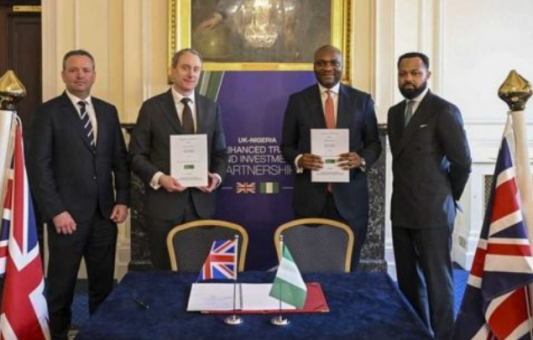
The Nigeria Sovereign Investment Authority (NSIA) has partnered with UK-based Asset Green Ltd to launch a $496 million integrated dairy production and processing project aimed at boosting food security and reducing Nigeria’s reliance on imports.
The agreement, formalised through a Memorandum of Understanding signed in London, marks one of the most ambitious private-sector-led agricultural investments in Nigeria.
According to a statement from the United Kingdom High Commission in Abuja, the initiative is designed to modernise Nigeria’s dairy sector and expand local production capacity.

The project is projected to generate about $620 million in annual revenue while creating 2,500 direct jobs and an additional 5,000 indirect employment opportunities across the country.
It will feature 20,000 hectares of climate-smart, regenerative farmland supporting a 10,000-cow dairy operation, alongside a state-of-the-art processing facility for producing milk, butter, cream, and powdered dairy products.

The plant is also expected to produce up to 15,000 metric tonnes of infant formula annually, strengthening local supply and improving nutrition.
In addition to industrial output, the initiative aims to integrate 10,000 rural households into the supply chain through out-grower schemes, helping to modernise farming practices and enhance livelihoods.
British Deputy High Commissioner to Nigeria, Jonny Baxter, described the partnership as a reflection of long-standing economic cooperation between the UK and Nigeria.
He noted that the UK had supported the establishment of the NSIA over a decade ago, adding that the current deal demonstrates the impact of sustained institutional collaboration.
NSIA Managing Director, Aminu Umar-Sadiq, described the project as a “generational shift” in Nigeria’s food system, emphasising its potential to build a modern and competitive dairy industry.
Similarly, Director of Asset Green Ltd, Rod Bassett, said the investment would unlock Nigeria’s agricultural potential by delivering advanced infrastructure across the production value chain.
He added that the initiative would enhance food sovereignty, improve nutritional outcomes, and significantly reduce the country’s dependence on imported dairy products.
The project is expected to play a key role in strengthening Nigeria’s agricultural sector and driving long-term, sustainable economic growth.