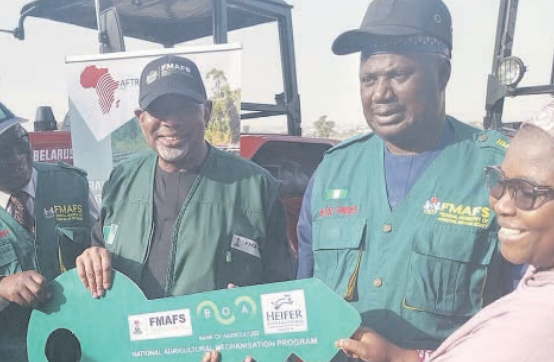
The Federal Government has launched an ambitious agricultural mechanisation drive with the rollout of 2,000 tractors and more than 9,000 precision farming implements aimed at transforming food production nationwide.
Minister of Agriculture and Food Security, Abubakar Kyari, announced the initiative in Abuja, describing it as the largest mechanisation programme ever undertaken in Africa.

Under the Renewed Hope National Agricultural Mechanisation initiative, the equipment will be deployed in phases, beginning with 600 tractors, followed by 750 and 650 units respectively.

Kyari said the programme is designed to address Nigeria’s long-standing mechanisation gap and support over 1.2 million farmers cultivating more than 1.5 million hectares annually.
“This is not merely an equipment rollout; it is the ignition of a National Agricultural Productivity Revolution,” he said, noting that over 10,000 applications had already been received for the first phase.
Service-Based Deployment Model
The minister clarified that the tractors would not be distributed for personal ownership but deployed through certified mechanisation service providers to ensure optimal use.
“Each tractor, with the capacity to service approximately 600 hectares per year, becomes a multiplier of productivity,” he said.
In addition, each tractor will come with two years of free service support, while mobile workshops and seven mega mechanisation centres will be established nationwide to guarantee maintenance and sustainability.
Kyari also revealed plans to establish a local tractor assembly plant capable of producing between 2,000 and 4,000 units annually, signalling a push toward building domestic industrial capacity.
The programme is backed by a N50 billion agricultural finance facility supported by the World Bank, Heifer International, and other technical partners.
Bridging the Mechanisation Gap
Minister of State for Agriculture and Food Security, Aliyu Abdullahi, noted that Nigeria’s mechanisation density stands at 0.27 horsepower per hectare — far below global and African averages.
He explained that mechanised farming would significantly cut production time and improve yields, especially for smallholder farmers who cannot afford to purchase tractors outright.
Managing Director of the Bank of Agriculture, Ayo Sotinrin, said the initiative was structured to create a sustainable mechanisation ecosystem through leasing models, service-based repayment systems, and partnerships with state governments and private operators.
Nigeria currently has about 13 tractors per 100 square kilometres of arable land, compared to the global average of 200, while more than 95 per cent of farmers still rely on manual labour.
Sotinrin said the new programme aims to reverse this trend by ensuring each tractor generates sustainable revenue and reinvestment opportunities.
Officials say the mechanisation push will enhance food sovereignty, create jobs, empower women farmers — who account for nearly 70 per cent of agricultural production processes — and strengthen Nigeria’s economic resilience.