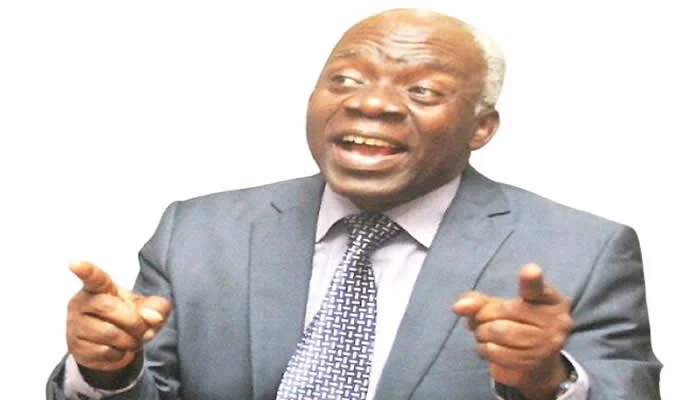
Prominent legal and civil society figures, including human rights lawyer Femi Falana and Aare Ona Kakanfo of Yorubaland, Gani Adams, have raised alarm over what they describe as growing judicial interference in Nigeria’s political space, warning it could result in a single presidential candidate in the 2027 elections.
They spoke at the fifth memorial lecture held in honour of Yinka Odumakin at the Airport Hotel, Ikeja, Lagos, where several labour leaders, activists and legal practitioners gathered to assess the state of Nigeria’s democracy.
Falana, who delivered the keynote lecture, criticised the judiciary for issuing conflicting court orders that, according to him, destabilise political parties and undermine democratic processes. He warned that continued manipulation of the courts could eliminate political competition.

“Through the manipulation of courts, Nigeria may end up with only one presidential candidate. At that point, conducting elections may become unnecessary,” he cautioned.
His remarks followed a recent decision by the Independent National Electoral Commission (INEC) to withdraw recognition of factions within the African Democratic Congress (ADC), citing a Court of Appeal directive to maintain the status quo pending the resolution of a leadership dispute.

Falana stressed that the Electoral Act prohibits judicial interference in internal party affairs, warning that actions perceived as undermining democratic choice could spark unrest among citizens.
He urged civil society organisations and labour unions to mobilise effectively to defend democracy.
Echoing similar concerns, Adams warned that Nigeria was gradually drifting towards a one-party state, drawing parallels with the political repression of the military era.
“We are moving dangerously close to a one-party system where opposition voices are silenced through judicial means,” he said, urging Nigerians to speak out against injustice regardless of ethnic or political affiliations.
Other speakers at the event included Nigeria Labour Congress President Joe Ajaero, activist and publisher Omoyele Sowore, and Senior Advocate of Nigeria Olumide Fusika, among others.
In his lecture titled “Can Nigeria’s Democracy Work without Restructuring?”, Falana argued that Nigeria currently operates a quasi-unitary system, with excessive powers concentrated at the federal level. He noted that while some reforms have occurred through court rulings—particularly on Value Added Tax and local government autonomy—state governments have failed to fully utilise devolved powers in areas like electricity and railways.
Falana also warned against potential abuse of state police by governors, citing historical precedents, while criticising the political elite for monopolising national resources such as oil blocks and mining licences.
Speaking at the event, Sowore accused the administration of Bola Ahmed Tinubu of pushing Nigerians toward a potential revolution, while Ajaero advocated restructuring, devolution of powers, and localised resource control as solutions to the country’s challenges.
The memorial lecture, hosted by the Oluyinka Odumakin Foundation, brought together key voices in Nigeria’s pro-democracy movement, all calling for urgent reforms to safeguard the nation’s democratic future.