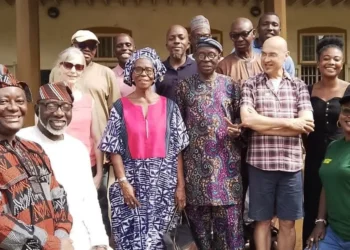
High drama unfolded at Mapo Hall, Ibadan, yesterday as the Oyo State Government conferred Obaship titles on three prominent chiefs—Senator Sarafadeen Alli, Oba Oyekola Babalola, and Oba Akeem Mobolaji Adewoyin—despite their absence at the ceremony.
Senator Alli was elevated as Ekarun Balogun, Oba Babalola as Ekarun Olubadan, and Oba Adewoyin as Ekerin Balogun of Ibadanland. Observers say their absence, coupled with the decision to crown them in absentia, carries political undertones, sparking speculations about potential preemptive moves ahead of the 2027 gubernatorial election.
Governor Seyi Makinde, who officiated the ceremony, highlighted the enduring importance of the traditional institution, calling it a pillar of stability, identity, and continuity in Ibadanland. He urged the newly installed chiefs to lead with integrity, wisdom, and a commitment to unity while fostering collaboration between traditional rulers and government for peace and development.

“There are moments in the life of a people when history, culture, and governance converge to produce an enduring legacy. Today is one of such moments,” Makinde said, affirming that the event followed the Chiefs’ Law of Oyo State and established customs.
The ceremony drew top state officials, including Secretary to the State Government Prof. Musbau Babatunde, commissioners for Local Government and Chieftaincy Matters Ademola Ojo, Culture and Tourism Wasiu Olatunbosun, and Head of Service Olubunmi Oni, along with traditional rulers from across the state.

Meanwhile, constitutional lawyer Adebisi Adeyemo stressed that no Nigerian citizen can be barred from contesting elective offices based on chieftaincy expectations. Citing Sections 65, 66, 106, and 107 of the 1999 Constitution, he clarified that eligibility for a traditional stool does not restrict political rights.
“Individuals who are merely eligible or nominated for a throne retain full political rights. Only those formally installed as traditional rulers may observe political neutrality,” Adeyemo said, referencing historical examples like Oba Adesoji Aderemi, M.K.O. Abiola, and Nnamdi Azikiwe to illustrate the coexistence of traditional status and political engagement.
The lawyer warned that any administrative or customary attempt to limit political ambitions of the chiefs, including Senator Alli, High Chief Adewoyin, and High Chief Babalola, would be constitutionally invalid and subject to judicial review.
The event, while historic in celebrating Ibadan’s cultural heritage, has ignited political debates over the intersection of chieftaincy, governance, and electoral ambitions, underscoring the delicate balance between tradition and democratic rights in Oyo State.
Governor Makinde concluded by calling for unity and collaboration, urging all stakeholders to respect the Constitution and uphold peace, stability, and the integrity of Ibadan’s traditional institutions.
This version balances the cultural significance of the event with the political implications, making it newsworthy for a national audience while emphasizing the legal perspective.