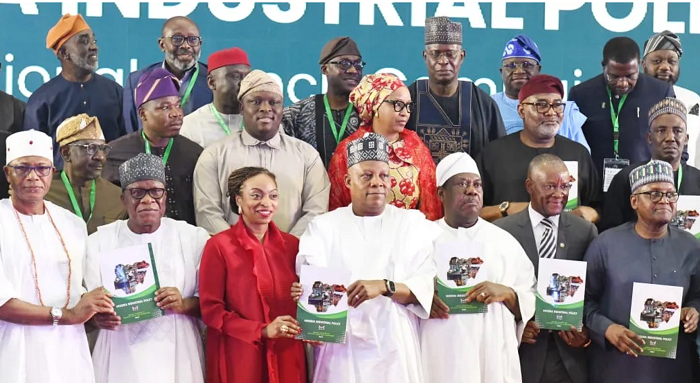
Bola Ahmed Tinubu yesterday highlighted the immense contributions of Dangote Cement, which paid about N900 billion in taxes in 2025, while unveiling the Nigeria Industrial Policy 2025, a framework aimed at transforming Nigeria into a competitive industrial hub.
Speaking through Kashim Shettima, President Tinubu lauded manufacturers who generate their own energy, noting that Dangote Cement produces more power than many Nigerian states — a “plus for the African continent.”
This policy is not about documents but about results factories opening at dawn, jobs for our youth, exports bearing the mark of Nigerian excellence, and value retained within our economy,” Tinubu declared.

The Nigeria Industrial Policy 2025 emphasizes:
Strengthening strategic sectors based on Nigeria’s comparative and competitive advantages.
Developing value chains to shift the country from raw material exports to finished goods production.

Integrating micro, small, and medium enterprises into industrial growth.
Aligning infrastructure and energy with industrial ambitions.
President Tinubu stressed that policies often fail in execution, not conception, and charged ministries, departments, and agencies to act swiftly in implementing the blueprint.
Aliko Dangote praised the administration’s reforms, highlighting the stability of foreign exchange and investor confidence.
He emphasized the need to protect indigenous industries to break the cycle of exporting raw materials and importing finished goods.
“The groundwork for real industrial growth is already being laid, from reviving dormant factories to processing more of our natural resources at home,” Dangote said.
The Manufacturers Association of Nigeria, led by Otunba Francis Meshioye, pledged full support for the policy’s implementation, particularly in promoting indigenous entrepreneurship.
Senator John Owan Enoh described the policy launch as a turning point for Nigeria, asserting that industrialization is now a national priority.
Mohamed Malick Fall said the policy represents a collaboration between Nigeria and the United Nations Industrial Development Organisation (UNIDO) to position the country as a key player in regional and global value chains.
The Nigeria Industrial Policy 2025 aims to create a competitive, value-driven industrial ecosystem, prioritizing execution, coordination, and the retention of economic value within the country signaling a new era for Nigerian manufacturing and economic growth.