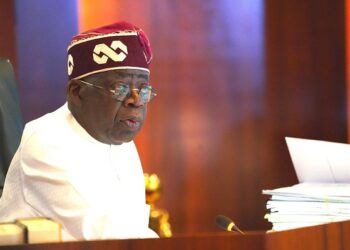
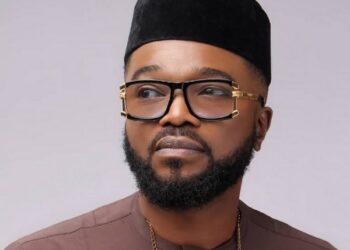
As political activities ahead of the 2027 general election gather momentum in Lagos State, former governor Akinwunmi Ambode is resurfacing in strategic calculations, amid reports that ruling party power brokers are working to defer Seyi Tinubu’s governorship ambition to 2031.
The contest for the Lagos governorship is already shaping up to be one of the most competitive in recent history, with high-profile aspirants, emerging power blocs, and an increasingly vocal electorate closely watching the unfolding permutations.

Seyi Tinubu, 40, son of President Bola Ahmed Tinubu, has been touted by several youth and diaspora groups as a potential contender for the Lagos governorship. In 2025, organisations including the Coalition of Nigerian Youth Leaders, The Future Platform, and some Nigerian diaspora groups openly urged him to declare interest in the race.
The development reportedly put the powerful Governance Advisory Council (GAC) in a delicate position, as Seyi Tinubu has neither formally declared his ambition nor received any public endorsement or comment from his father.

By 2027, Lagos State will constitutionally require a new governor, as incumbent Babajide Sanwo-Olu will complete his second and final term in office. However, sources within the All Progressives Congress (APC) say party leaders are considering a political arrangement that could see Ambode return to office to complete a second term, thereby paving the way for Seyi Tinubu in 2031.
Ambode, who served as governor from 2015 to 2019, fell out with Tinubu and Lagos APC leaders ahead of the 2019 election and was denied the party’s ticket, losing the primary to Sanwo-Olu, who went on to win the governorship.
Insiders say the GAC is now working to delay Seyi Tinubu’s governorship bid, citing party continuity, public perception, and long-term strategic planning.
Although Seyi Tinubu was reportedly interested in the race earlier, he was advised to keep a low profile and focus on mobilising support for his father’s second-term bid.
“The party leadership viewed his ambition as a potential distraction to his father’s re-election, especially with the growing opposition to the current government,” said Segun Badejo, an APC chieftain in Gbagada.
The GAC, a 30-member political body established by President Tinubu during his tenure as Lagos governor in 1999 and led by Prince Tajudeen Olusi, includes former governors and deputy governors, past speakers of the Lagos State House of Assembly, current and former senators, and respected party elders. The council played decisive roles in the emergence of former governors Babatunde Fashola, Akinwunmi Ambode, and Governor Babajide Sanwo-Olu.
A party insider disclosed that if President Tinubu secures re-election in 2027 and completes his tenure by 2031, Seyi Tinubu is expected to step into the Lagos governorship race to sustain his father’s political legacy.
Another factor driving the Ambode resurgence, sources said, is lingering anger in the Epe division over the circumstances surrounding his removal from office.
Lagos State is administratively divided into five districts—Ikorodu, Badagry, Ikeja, Lagos Island, and Epe—collectively known as IBILE. While Tinubu, Fashola, and Sanwo-Olu, all from Lagos Island, completed two terms, Ambode, from Epe, remains the only governor denied a second term.
This has fuelled discontent among stakeholders in Epe, who insist their zone was politically shortchanged. Although Tinubu later appointed Tunji Alausa as Minister of Health and subsequently Minister of Education, many in Epe argue that the district deserves another chance at the governorship.
Stakeholders from the area are demanding that either Ambode or Alausa succeeds Sanwo-Olu in 2027.
A senior APC stakeholder in Ikeja, who spoke on condition of anonymity, said the strategy was not aimed at sidelining Seyi Tinubu.
“The idea is to give him a more stable runway. Nigeria may not accept a situation where a father is president and his son is governor at the same time,” the source said.
“The party also wants to avoid a repeat of 2023, when the Labour Party defeated President Tinubu in Lagos. Right now, the consensus is that Ambode or Alausa stands a better chance of carrying the party in 2027.”
Meanwhile, the 2027 field is already crowded. Political heavyweights being mentioned include Chief of Staff to the President, Femi Gbajabiamila; Speaker of the Lagos State House of Assembly, Mudashiru Obasa; Senator Tokunbo Abiru; and Abdul-Azeez Adediran, popularly known as Jandor.
A community leader from Epe, Olumide Balogun, said the district would not accept further marginalisation.
“We have watched other regions monopolise power. It’s time for Epe people to be heard. Either Tunji Alausa or Ambode should be our next governor,” he said.
Political observer Edafe Oghenebrume warned that failure to field a candidate from Lagos West Senatorial District could spell trouble for the APC.
“Since 1999, Lagos West has been marginalised in terms of the governorship. Ignoring that reality could lead to serious electoral challenges,” he cautioned.
So far, only Jandor, a former PDP governorship aspirant who defected to the APC in October 2025, has openly declared his ambition.
“Lagosians deserve a fresh vision that blends experience with innovation,” Jandor said, expressing confidence that with party and presidential backing, victory would be assured.
Across the state, residents are watching developments with a mix of anticipation and skepticism. While some prioritise experience and stability, others—particularly younger voters—are calling for inclusiveness, fresh ideas, and practical governance over political calculations.
As the countdown to 2027 continues, one thing is clear: the Lagos governorship race will be fiercely contested, closely watched, and pivotal to the future political direction of Nigeria’s commercial capital.